ChatGPT for Lead Generation – AI for Lead Generation (Part 2)
How we built a headless version of ChatGPT for lead generation

Over the past year, we spent a lot of time working closely with teams who were already using ChatGPT in their day to day work. Some of this was through training, some through consulting, and some through building internal tools together.
Naturally, people were using ChatGPT in ways we had not initially expected.
One use case that stood out, and that I was also using myself, was a specific type of lead generation.
How teams were using ChatGPT
ChatGPT has developed the ability to search the web and iteratively evaluate the information it retrieves while forming an answer.
One example of how teams were leveraging this capability came from a client who was analysing job postings published by recruiters where the hiring company was not disclosed. The client would copy the full job description into ChatGPT and ask it to infer which company was likely hiring for the role.
ChatGPT could identify that these job descriptions often contained useful signals, including references to tooling, responsibilities, internal processes, and occasionally customers. It then would search for the type of company that might require such a role, search the web, review the results, reject weak matches, refine its assumptions, and search again.
This back and forth would continue for a short period before ChatGPT returned an answer.
Why existing lead tools struggled with this
Most web search based lead generation platforms are designed around a fixed query. They retrieve and rank results based on that query and return the highest scoring matches. This works well when the same search logic applies across many leads.
The limitation appears when the search logic itself needs to change. If each lead requires a different query, shaped by factors such as the language, tools, or context in a specific job description, a single query model is no longer sufficient. In those cases, accuracy depends on adapting the search strategy for each individual lead, which most platforms are not designed to do.
In this the clients case above, their problem was not retrieving data. The problem was deciding what to search for in the first place, and then deciding whether the result was actually correct.
At small scale, a human can review and correct errors. At large scale, that is not practical.
The limits of using ChatGPT directly
Using ChatGPT manually also has obvious limitations.
Every step required copying and pasting. There was no way to run the process continuously or at scale. You also had very little control over how long the model would reason for. You could ask it to repeat a task forty times and it would politely do five, then stop.
There was no consistent way to apply lead qualification criteria across outputs.
Most importantly, there was no way to automate the workflow end to end.
People had found something genuinely useful, but they were essentially supervising an enthusiastic intern who needed constant instructions, one lead at a time.
Building a headless version of the behaviour
There was no API or product we could find that allowed us to build a headless, scalable version of ChatGPT for lead generation.
The closest option was the Perplexity API, which provides access to live web search and high quality synthesis. However, it executes a single search pass and does not continue querying or refining its strategy until a sufficiently confident answer is reached.
The first step was data collection. We scraped job postings using computer-using agents, which allowed us to reliably extract the full content of each role. I wrote in more detail about this approach in a previous post..
We introduced a reasoning layer that worked with the live search system. Its job was not to answer the question directly, but to decide which searches should be run. The software was able to reseach multiple hypotheses based on the job description and searched for evidence to confirm or rule each one out.After each round of search, the system evaluated the results. This process repeated until the system reached a sufficient level of confidence in the outcome.
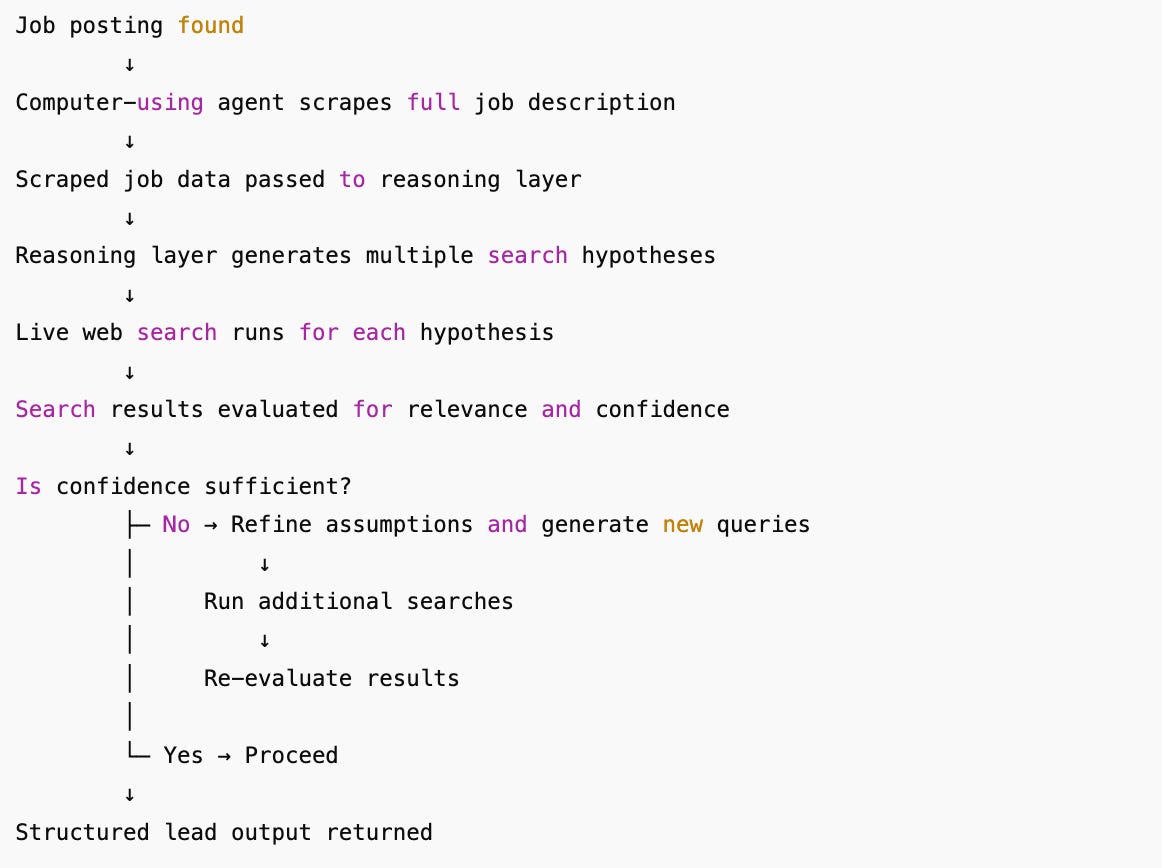
The entire workflow ran without a user interface. There were no manual steps, and no human intervention once the system was started.The result was a system that behaved much more like a human researcher, but at machine speed.
It could look at partial information, test assumptions, discard incorrect paths, and refine its understanding over time. It could also apply consistent criteria for what qualified as a good lead.
In practice, this approach proved more accurate than manually pasting leads into ChatGPT.
Conclusion
What started as an observation during customer work turned into a way to scale something people were already doing manually in ChatGPT.
We are still actively exploring this space, and we would genuinely like to hear how others have approached similar problems, or whether you have tried to solve this in a different way.
If you are interested in using the platform or discussing the approach in more detail, feel free to get in touch at louisamay@callmintelligence.com.